
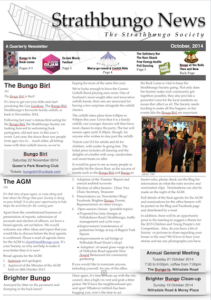
 The new Strathbungo Society Newsletter is off to the printer’s. Thanks to Alison, Allison, Bryan, Stephen and Teresa for reviewing it and catching several errors and omissions. This edition features articles by Angela Fulton, Lucy Gillie, Alison Hunter, Deidre Miller, Samantha Moir, Teresa Mooney and Kris Shelton. If you’d like to read the full-colour electronic version rather than the black and white print version, then click on the image on the left to open the pdf in a new tab.
Author: Deidre Miller (Page 1 of 4)
 This calico cat has recently taken over a ground floor under-the-wood-board property in our back garden and given birth to a litter of adorable kittens. She doesn’t look like a stray, does she? She seems to be healthy and well fed, but understandably, she won’t let anyone near her babies. She looks young herself. Did she perhaps escape from someone’s house? She’s obviously not been fixed, but she doesn’t exactly seem feral. If she has a home, then please let us know. We’ll be feeding her and waiting to see if she gets any friendlier. If she’s your cat, please e-mail news-atsign-strathbungo.co.uk
 When I took over the BungoBlog maintenance, I thought that contributors were automatically added when they confirmed their e-mail addresses. Not so, as it turns out! I just approved a whole bunch of unverified accounts. Any that didn’t look real, I deleted.
BungoBlog gets dozens of fake registrations from spammers every month, so it’s possible that some of the people I approved are spammers, even though I tried to filter them out. If spam appears, I’ll try to catch it ASAP, delete it, and give the person/bot responsible the boot.
If you’ve tried to register for BungoBlog in the past and weren’t able to sign in, then your account will probably be working now.
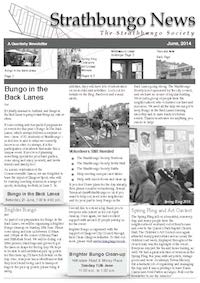 The June Strathbungo Newsletter has just gone out to the printer’s. It features the Community Art Contest Winners, Bungo in the Back Lanes and a story on architectural conservation by Fiona MacKinnon. Fiona, I owe you an apology. Your name is missing from the back page of the print version – so sorry about that, I noticed it a day after sending it to the printer – but I’ve corrected the oversight on the electronic version.
Just click on the cover to download the pdf.
Also..
The Brighter Bungo litter clean-up is this Sunday, June 15th at 11:00 am.
It’s in the newsletter, but unfortunately, it won’t be printed and distibuted in time to let everyone know.
There’s also a handy BITBL map in the newsletter. It includes numbered lanes and a list of the stuff (that we know about) planned for the day. Of course, there will be more going on. It’s left up to neighbourhood residents to put together whatever they think will be fun, useful, thought provoking, artistic, profitable, or whatever. The Strathbungo Society creates space for Bungo in the Back Lanes by jumping through the regulatory hoops – but we don’t micromanage it.
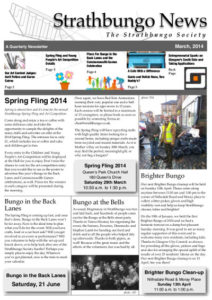 The March Strathbungo News has gone to the printer. To access a colour pdf, just click on the picture of the cover.
Thanks to everyone who contributed, especially Teresa Mooney for her articles and photos, and Andrew Downie and Stephen Rees for their helpful comments.
 I made a logo for the Strathbungo Games. Copyright issues abound!
 The December newsletter is done and will be delivered all over Strathbungo within the next week or two. I think it’s a good issue. Thanks to a great effort by Nick Kempe, who has been attending the Glasgow Civic Forum, we have an article on saving energy in traditionally constructed buildings by Moses Jenkins of Historic Scotland, plus an article on burglary prevention and an update on enforcement from the Gorbals Police Office. We’ve also got a good local enterprise section. I had a very pleasant chat with Sam and Anna of bakery47, and interviewed Rosie Ilett about her crafting. Thanks to Sharon Schweps and Vivienne McGregor for their articles, and of course thanks to everyone who took the time to look over the draft. To view the newsletter, click on the image.
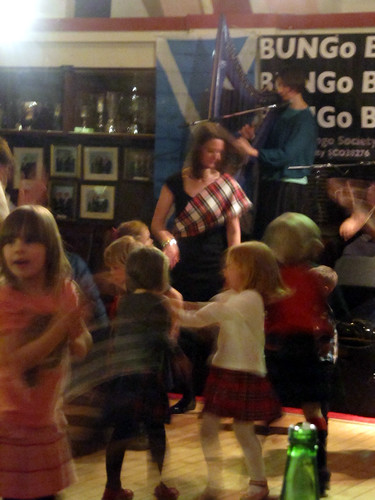 The BungoBirl was a success, with a huge crowd of people, a fantastic live band, great raffle prizes, fantastic food from Babu Bombay Street Kitchen and Bakery47 and a perfect venue and (importantly!) cheap booze from the Queen’s Park Bowling Club. Thanks most of all the the organizers, Paola, Allison and Allison. Brilliant idea and execution.
It had more kids in kilts than even a wedding, so naturally there was adorableness to spare. I’ve posted a set of pictures of the event on the Strathbungo group on Flickr, and anyone else who took pictures is invited to do the same. If you need instructions, just ask in the comments. The pictures can be viewed, motion blurs and all, here.
 If you’re not getting any water, then don’t worry. A water main has burst on Bridge Street and people in G5, G41, G42, G43, and G45 may have lost their water supply. To find out more, see Scottish Water’s Service Updates webpage.
Update: We have our water back this morning. Hopefully everyone else does, too. Thanks to all the people who spent the night fixing things, whoever you are.
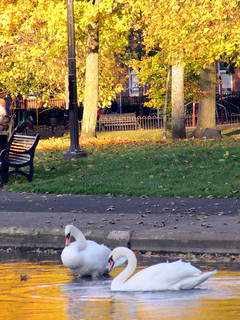 Have you ever gotten annoyed by all the litter in Queen’s Park? It’s a gorgeous park that was designed by a famous Victorian landscape architect: Sir Joseph Paxton, who also designed the Crystal Palace in London. It’s a shame that so many people think it’s okay to treat this beautiful, historic park like a dump. Well, now we have a way to help out with the problem.
The Friends of Queen’s Park have organised a cleanup for Saturday, 23rd November at 10:00 am. The group will meet at the main gates at Victoria Road. It will work much like Brighter Bungo, with the City Council providing equipment and support. If you can make it, the Friends of Queen’s Park would love for you to opt in on their Facebook page. However, if you find that you just want to show up on the day, that’s fine, too.

© 2024 The Strathbungo Society
Theme by Anders Norén — Up ↑
Recent Comments